

The number of transgender services performed at Planned Parenthood clinics skyrocketed in recent years as the transgender medical industry became very profitable, based on data published by the organization’s regional branches.
Planned Parenthood initially began providing hormone treatments for transgender patients in 2005, and as of 2022, 41 out of 49 regional branches have offered transgender services. However, in just the past three years, Planned Parenthood has significantly expanded its involvement in the gender hormone industry.
Between 2020 and 2022, the number of transgender services performed and/or visits related to transgender treatments at Planned Parenthood clinics rose by about 125%, according to a Daily Caller News Foundation review of available data. Regional branches collectively recorded 17,036 visits in 2020 compared to 38,337 in 2022, a significant increase in a short time.
Michael Artigues, president of the American College of Pediatricians, expressed that the recent increase is likely due to various factors such as transgenderism becoming a growing “social phenomenon” and potential financial incentives.
“You have to be concerned about the fact that there’s always money involved, for sure,” Artigues said. “And you’ve got to question whether or not they’re discerning if someone, in particular minors, have a legitimate condition that requires treatment like gender-affirming therapies, as opposed to a social phenomena and or simply mental health problems.”
While the national Planned Parenthood organization does not publicly share data on visits related to transgender medical services, 12 of the 41 regional Planned Parenthood branches have released relevant data over the past three years. The remaining branches did not respond to the DCNF’s requests for comment.
The regional offices used various methods to track gender services, with some monitoring gender hormone therapy appointments and others tracking visits to their “gender-affirming care” programs. Many of the regional Planned Parenthood organizations that published their data saw a substantial increase in visits and/or services performed for transgender individuals. Many clinics currently provide “Transgender Hormone Therapy” including estrogen, testosterone, and puberty blockers.
Planned Parenthood Mar Monte, with clinics in California and parts of Nevada, recorded 1,041 “gender-affirming care visits” in 2020, rising to 4,378 visits in 2022 and eventually reaching 9,288 in 2023, according to its annual reports. The clinic provides hormone therapy for patients who are 18 years and older, or for patients 16 to 17 years old with parental consent, according to its website.
Planned Parenthood Columbia Willamette, in Oregon, documented 344 transgender medical visits in 2018-2019 and 533 in 2019-2020. That number of visits increased to 1,066 in 2020-2021, and the following year it was nearly four times higher at 4,129 visits.
Planned Parenthood reportedly saw over 35,000 patients for hormone replacement services appointments in 2021, as NPR reported. The organization did not disclose the exact number of gender-related visits in its 2022 annual report but instead listed them under “other procedures,” which totaled 256,550 appointments and included services like pediatric care, other adult preventive care, and high complexity visits, including infertility services.
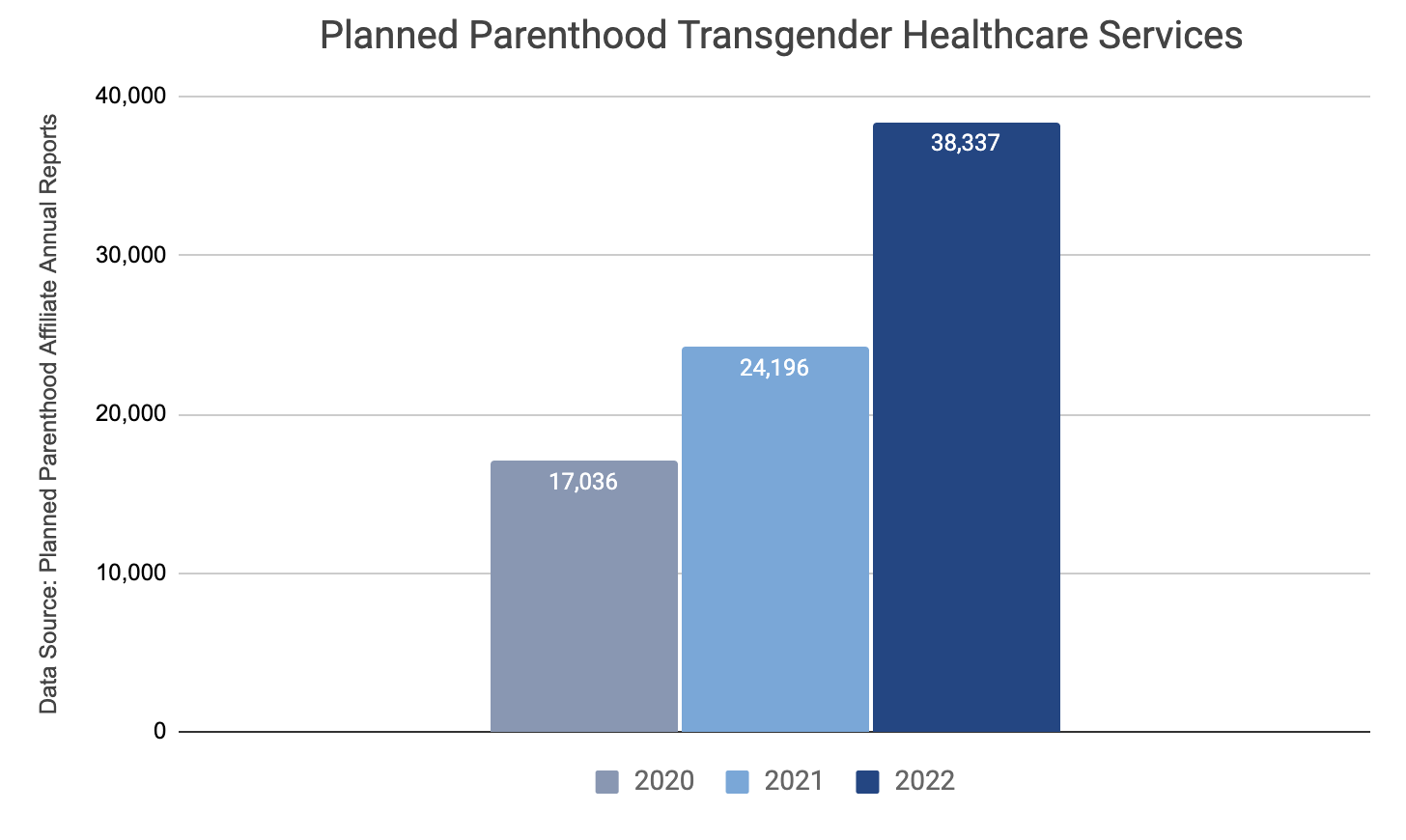
NOTE: The graphic includes Planned Parenthood’s annual totals for “Gender Hormone Therapy,” “gender-affirming” or transgender visits and services at 12 affiliates with reports from 2020 to 2022. (Megan Brock/Kate Anderson)
Several branches indicated that their transgender services were experiencing some of the most rapid growth among their clinics. Planned Parenthood Illinois stated in its 2022 report that its transgender hormone therapy is “growing faster than any other service.” The report also highlighted that “gender-affirming care requires a lifelong continuum of social, psychological, behavioral and medical care.”
Stella O’Malley, psychotherapist and executive director of Genspect, an international group that advocates for a “healthy approach to sex and gender,” conveyed that she believes Planned Parenthood has shifted from the “medical model, where doctors are bound by the principle to ‘first, do no harm,’ to a more business-like approach that lets“The purchaser should be cautious.”
“In this scenario, individuals who are especially susceptible and at their lowest often require direction and assistance, not a transactional approach,” O’Malley stated. “Doctors are not like store owners. They are compensated well because they have significant responsibilities and, therefore, need to fulfill these obligations by being empathetic to the patient’s needs. A standardized method that rapidly channels most patients into a medicalized process is entirely inappropriate.”
On the whole, the market for cross-sex surgeries is estimated to reach a value of $5 billion in 2023, due in large part to an increasing number of Americans identifying as transgender. The cost of regular medical consultations for a patient on gender hormones would also be substantial.
Only a small number of the entities assessed by the DCNF disclosed prices for their gender services; Planned Parenthood of the St. Louis Region and Southwest Missouri lists a “self-pay fee for a visit” at $250, with additional charges for any laboratory work. All follow-up visits cost $200, plus expenses to cover any necessary lab work.
Planned Parenthood Pasadena & San Gabriel Valley estimates costs of up to $262 for the initial visit, as well as $35 for hormone injection training and up to $48 for lab work. Subsequent visits can cost up to $202.
By 2022, Planned Parenthood Metropolitan New Jersey stated that its new patient consultation for transgender hormone treatment ranged from $92 to $206, while follow-ups were slightly less, ranging from $65 to $173, according to an introductory packet.
Scott Newgent, a detransitioner and founder of TReVoices, an organization that strives to prevent the medical transition of children, informed the DCNF that the nature of gender hormone treatments, which must be taken continuously for the rest of a patient’s life, creates potential repeat customers for organizations like Planned Parenthood.
“It doesn’t matter if they decide to transition or stay trans or whatever,” Newgent said. “They’re going to need those synthetic hormones for life. That’s a huge business model.”
Concerns have also been expressed by medical professionals regarding the ease with which individuals can obtain prescriptions for hormone treatments at Planned Parenthood. For instance, the Columbia Willamette affiliate states on its website that it offers hormone treatments for patients 18 years and older without requiring a letter from a counselor or doctor recommending hormones for gender dysphoria. Patients can obtain a prescription after the initial hour-and-a-half appointment.
Erica Anderson, a transgender individual and former president of the U.S. Professional Association for Transgender Health, stated that patients have bypassed more traditional methods of obtaining hormones due to the prolonged duration it takes, choosing to go to Planned Parenthood instead, as reported by the Washington Free Beacon.Hormone Therapy,” “gender-affirming,” or transgender appointments and services were provided at 20 locations from 2020 to 2022. (Megan Brock/Kate Anderson)
Planned Parenthood California Central Coast recorded 299 “gender-affirming care” initial and follow-up visits during the fiscal year 2019-2020, but saw an increase to 746 two years later in the 2021-2022 annual report. In 2020-2021, Planned Parenthood Wisconsin had 488 hormone therapy visits, which rose to 730 in 2021-2022.
Planned Parenthood Great Northwest reported only 659 “gender-affirming hormone care” visits in 2018 within the first six months of launching its gender program. By 2022, the number had surged to a remarkable 12,814 visits with 5,926 patients. Although the Great Northwest branch integrated the Indiana and Kentucky regions in 2021, those organizations did not report the number of transgender services in their previous annual reports.
There are significant health risks associated with transgender hormone treatments; minors can become infertile if they receive puberty blockers, while those who transition later could suffer from other conditions such as bone deterioration after trying to come off testosterone.
“Women who take testosterone for an extended period and then discontinue it may experience bone deterioration,” said Newgent. “So I have to resume testosterone to maintain bone health, but then I have to manage the other side effects. There are various medical complications that come with it.”
In July, Planned Parenthood released a series of videos acknowledging that patients who take estrogen hormones are at a higher risk of blood clots in the lungs, brain, and legs.
Risks associated with testosterone therapy include blood clots, low blood sugar, high cholesterol, and liver issues, according to the videos. Planned Parenthood also recommends that patients receiving hormone therapy should explore “family planning” options, noting that infertility is a potential side effect.
Planned Parenthood should “prioritize evidence-based medicine” and encourage patients, especially children, to receive “intensive psychiatric assessment and care” instead of providing puberty blockers, Dr. Stanley Goldfarb, chairman of Do No Harm, a group of medical professionals opposing “radical” ideology in healthcare, stated in a response to the DCNF.
Planned Parenthood did not respond to the DCNF’s requests for comment.
Leave a Comment