
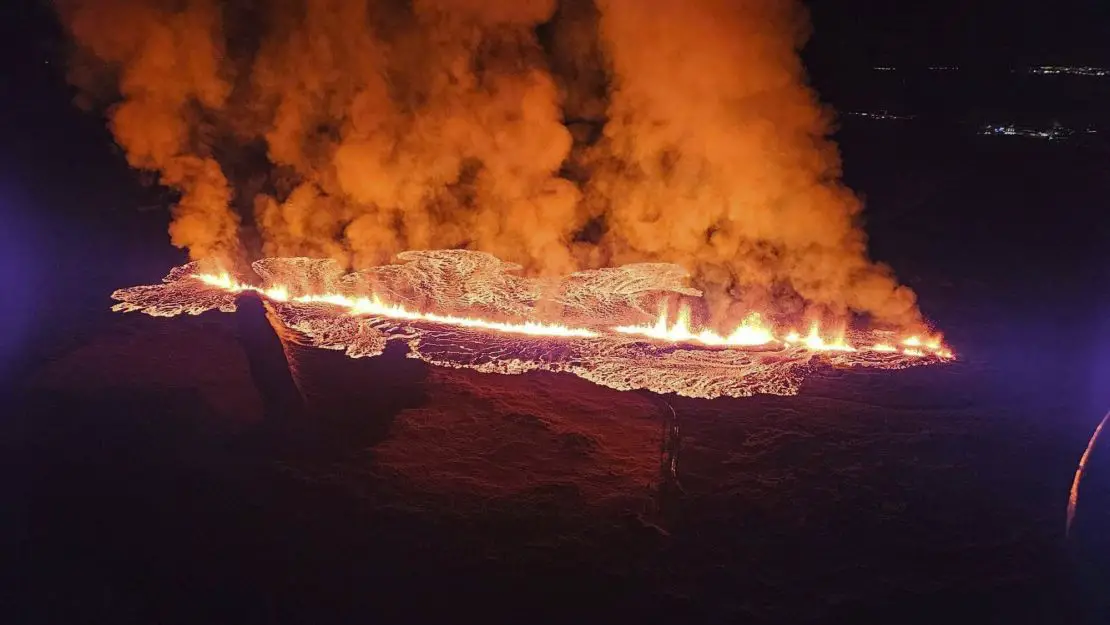

A state of emergency has been declared in Iceland after a volcano in the southwestern part of the country began to erupt, sending lava surging into the seaside town of Grindavík.
The town had been evacuated after a swarm of earthquakes shook the region overnight, raising fears of an impending eruption. The Icelandic Meteorological Office (IMO) reported over 200 earthquakes, with a magnitude 3.5 being the strongest recorded. This series of intense earthquakes was followed by major changes in GPS measurements and borehole pressure readings, which confirmed that magma was moving within the region. This led to the IMO warning about the high possibility of an eruption occurring imminently.
The first fissure opened at around 8 a.m. local time, southeast of Hagafell Mountain, about a half-mile from Grindavík. This prompted the evacuation of the town, with approximately 200 people present at the time, according to RÚV, a local news outlet. One resident shared her experience of being woken up by sirens and being forced to evacuate immediately after receiving alerts on her phone. Despite not being scared, she described her body trembling as the situation was new and uncertain.
As the day progressed, a second eruptive fissure opened just north of Grindavík, and lava began to flow into the town. Helpless residents watched as their homes were destroyed by the quickly approaching lava. At least three homes have been reported destroyed so far, and no new fissures have opened in the town. According to Iceland’s President Guðni Jóhannesson, no lives are in danger as the town had been successfully evacuated overnight. However, the infrastructure and heating supply pipes have been damaged due to the earthquakes and lava flow, as reported by RÚV.
Jóhannesson also stated that no flights had been affected by the volcanic eruption, which occurred south of the capital of Reykjavík. The President is expected to address the nation on Sunday night. Meanwhile, Iceland’s public service broadcaster RÚV reported damage to the electrical infrastructure and heating supply pipes. This has led to concerns about the town’s ability to sustain its residents in the aftermath of the eruption.
These aerial photos of Grindavík are unreal.
Credit: @almannavarnir pic.twitter.com/xbb1Q6JR1d
— Nahel Belgherze (@WxNB_) January 14, 2024
The eruption has also caused environmental concerns, with concerns about toxic gases and ash affecting air quality. The IMO has warned residents to stay away from the affected areas and to monitor air quality closely. The eruption has also disrupted travel plans for tourists, with some flights being diverted or canceled as a precautionary measure.
The latest series of events follows a recent increase in volcanic activity in the region, with the Grindavík volcano showing signs of unrest since the beginning of the year. This eruption is the first in the area since 2014 when a nearby volcano erupted for several weeks. The current eruption is ongoing, and the IMO continues to monitor the situation closely for any changes or developments.
The eruption has also sparked renewed discussions about Iceland’s preparedness for natural disasters, particularly volcanic eruptions. The country is known for its frequent volcanic activity, with over 30 active volcanic systems in the region. This event serves as a reminder for the Icelandic government and the local community to review and update their emergency response plans to ensure the safety and well-being of its citizens.
As the situation continues to unfold, the world watches and hopes for the safe containment and eventual resolution of the volcanic eruption in Iceland.
Leave a Comment