
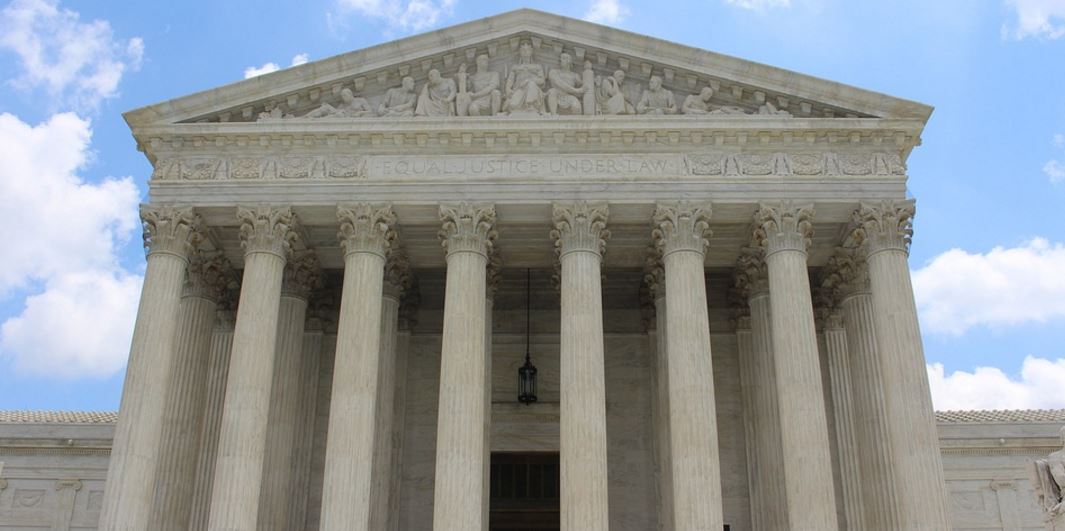

Courts nationwide, including the Supreme Court, annulled numerous First Amendment violations this year.
Judges turned down attempts to compel speech, clarified that states cannot control speech based on content, and safeguarded the right to express unpopular beliefs. While appeals in some cases will continue in the new year — like the Murthy v. Missouri case challenging the federal government’s communication with social media platforms to censor speech, which the Supreme Court agreed to consider — others resulted in final triumphs.
Invalidating New York’s ‘Hurtful Conduct’ Law
A federal judge stopped enforcement in February of New York’s online hate speech law, which mandates social media companies to “maintain mechanisms for reporting hateful conduct” on their platforms. The Foundation for Individual Rights and Expression (FIRE) suited last year on behalf of Eugene Volokh, in addition to online platforms Rumble and Locals.
“[T]he First Amendment protects from state regulation speech that may be deemed ‘hateful’ and generally disfavors regulation of speech based on its content unless it is narrowly tailored to serve a compelling governmental interest,” Judge Andrew L. Carter Jr. ruled. “The Hateful Conduct Law both compels social media networks to speak about the contours of hate speech and chills the constitutionally protected speech of social media users, without articulating a compelling governmental interest or ensuring that the law is narrowly tailored to that goal.”
New York appealed the ruling to the Second Circuit, which will likely hear oral arguments in early 2024, according to FIRE.
Upholding The Freedom To ‘Express Consistent’ With Your Convictions
The Supreme Court supported Christian web designer Lorie Smith in June, determining that Colorado’s Anti-Discrimination Act (CADA), which prevents public accommodations from restricting services based on sexual orientation, cannot compel her to design custom wedding websites for same-sex couples in violation of her religious beliefs.
“The First Amendment envisions the United States as a rich and complex place where all persons are free to think and speak as they wish, not as the government demands,” Justice Neil Gorsuch wrote in the majority opinion.
Smith told the Daily Caller News Foundation shortly after her victory that the ruling makes everyone more free to “speak consistent with their convictions.”
“This ruling protects the LGBT website designer, the Jewish calligrapher, the Democrat speechwriter, the pro-life photographer,” she said.
Preventing Biden Administration From Collaborating With Big Tech To Censor
A case the Supreme Court has now agreed to hear, Murthy v. Missouri, made waves this year after a federal district judge issued an injunction in July barring the Biden administration from coordinating with social media companies for the purposes of censoring speech. District of Louisiana Judge Terry A. Doughty labeled the federal government’s efforts “Orwellian” and said the plaintiffs produced evidence that they were “victims of a far-reaching and widespread censorship campaign.”
The Fifth Circuit later narrowed the injunction to cover the White House, the surgeon general, the Centers for Disease Control and Prevention (CDC), FBI and Cybersecurity and Infrastructure Security Agency (CISA). The Supreme Court paused it in October pending review.
‘God Bless The Homeless Vets’
The City of Port Wentworth, Georgia, reached a agreement in November with Jeff Gray, who was arrested after he stood in front of city hall with a sign that said “God Bless the Homeless Vets” and refused to leave at an officer’s request. The city donated $1,791 — representing the year of the First Amendment’s ratification — to the National Coalition for Homeless Veterans as part of the settlement, according to FIRE, which filed the lawsuit.
“Port Wentworth found out the hard way that it can’t try to bulldoze my rights and get away with it,” said Gray in a statement. “I’m thankful for the outcome here, but I won’t stop speaking out on behalf of myself and my fellow citizens.”
Gray has run a YouTube channel since 2011 where he conducts “civil rights investigations” in various southeastern U.S. towns, sharing his interactions with the police.
Vindicating America’s Founding Documents
The American Center for Law and Justice (ACLJ) sued the National Archives in February on behalf of visitors who were told to leave the museum for wearing pro-life apparel. The National Archives agreed in December to pay the plaintiffs, who were visiting Washington, D.C., for the March for Life when they were kicked out, $10,000 to settle the case, according to a court document.
“This is an especially important victory, as one month from today, pro-life Americans will once again gather in Washington, D.C., for the March for Life,” ACLJ said in a Dec. 19 statement. “Our victory today ensures that they will be free from harassment and that their First Amendment rights will be protected should they choose to visit the National Archives and view the very documents that protect those sacred rights.”
Assigning Unequal Enforcement To Censorship
During the same period in the summer of 2020 when Black Lives Matter protesters in Washington, D.C., were covering public spaces with paint and chalk, the city arrested two pro-life activists who chalked the words “Black Pre-Born Lives Matter” on a public sidewalk outside of a Planned Parenthood facility. The D.C. Circuit Court of Appeals found in August that a lower court had wrongfully dismissed their lawsuit, which accused the city of violating their First Amendment rights.
“The government may not enforce the laws in a manner that picks winners and losers in public debates,” the D.C. Circuit opinion stated. “It would undermine the First Amendment’s protections for free speech if the government could enact a content-neutral law and then discriminate against disfavored viewpoints under the cover of prosecutorial discretion.”
Leave a Comment