
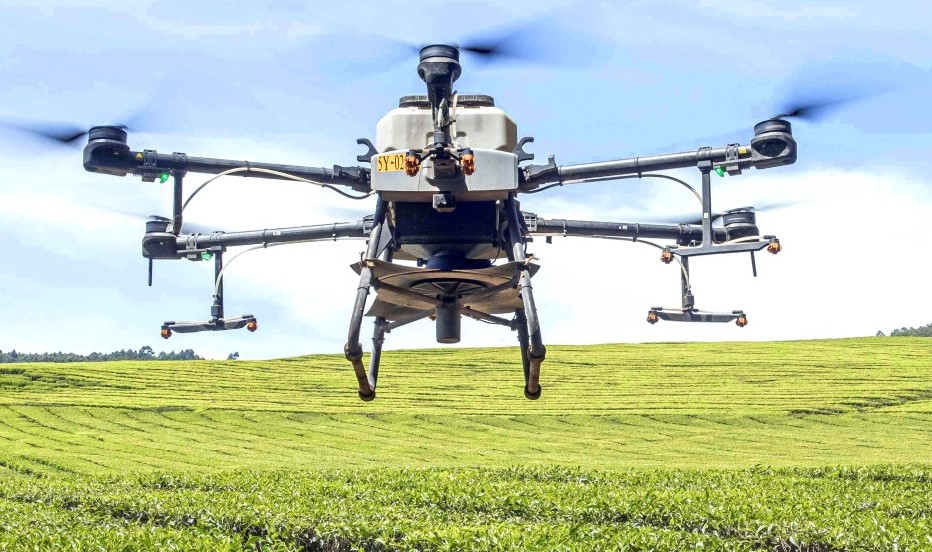

Early one recent morning in Vidalia, Georgia, third-generation farmer Greg Morgan launched an AG-230 drone carrying eight gallons of fungicide over a field of sweet onions. The chemical, necessary for crop survival in this humid state, would typically be dragged and dripped from a 500-gallon tank behind Morgan’s 10,000-pound tractor. Now it fell in a fine mist from the spray jets of an 80-pound drone skimming 10 feet above his cash crop.
Vidalia Onions are a $150 million local industry….Morgan has joined the vanguard of farmers who are turning away from tractors and toward drones…Farmers have been using drones over the past 20 years mainly for aerial imaging — surveying farms from the sky with cameras to map where crops are thriving and failing. Now drones are being designed for hands-on crop management: capable of spraying herbicides, insecticides, and foliar fertilizers precisely, and even distributing seeds during planting season.
A “featherweight flying tractor” — that’s how Arthur Erickson, chief executive of manufacturer Hylio Inc., described the company’s agricultural drones. The Houston-based startup has seen a surge in demand for its drones over the past three years; roughly 700 of Hylio’s drones are now at work treating 700,000 acres of cropland annually — including Morgan’s farm….Drones are poised to significantly disrupt the tractor industry, and unlike many other high-tech agricultural trends, this one is actually positive for small and midsized farmers, and a substantial victory for the planet, to boot.
In the eight months since Morgan made his $40,000 investment — a lot cheaper than the roughly $700,000 it would have cost to replace his old ground rig — it has cut his fuel costs and already reduced his agrochemical usage by about 15%. The drone has also enabled him to work his fields after heavy rains — when the ground is often too sodden for heavy equipment — and has spared his crop from the routine damage caused by tractors. It has also saved his soil from the compaction, bogging, and erosion caused by farm machinery.
A Bloomberg News reporter first witnessed a farm drone (“agrodrone”) at work in 2022 on a large soy and corn farm in Iowa. The farm owner launched an MG-1P Rantizo drone made in China that was 9 feet wide with 8 propellers. For an entire morning, the farmer guided his drone to spray an organic pesticide at a rate of 2 gallons per acre and 14 acres per hour. That afternoon, it switched tasks and dropped rye seeds across soy fields at a rate of 25 pounds per acre. As Bloomberg News notes, “These aerial acrobats use less than a tenth of the energy of ground tractors — and they don’t squash the crops, rut the earth or even touch the soil.” More than the large soy and corn farm, Morgan’s small “onion farm offered even more convincing evidence….Morgan struggles to stay profitable on his 300 acres. The drone purchase for him was not a whiz-bang new toy, but a survival tool that allowed him to minimize his expenses.”
Drones are rapidly becoming more advanced:
As the hardware of agrodrones becomes increasingly sophisticated — with smaller, longer-lasting batteries and lighter, stronger carbon-fiber frames — so does the software, which is being developed by startups such as Canada’s Precision AI. The AI software will enable drones to use computer vision to identify exactly where and how much chemical is needed, plant by plant rather than blanketing an entire field with the same treatment.
Drones won’t completely replace tractors anytime soon. Their payload is limited to about 20 gallons, not nearly enough to handle the hundreds-of-pounds-per-acre fertilizer applications required between harvests. But they’re certainly capable of displacing the expensive, wasteful crop-dusting of herbicides and fungicides still performed by airplanes and helicopters across millions of acres.
Whereas crop-dusting spreads chemicals that bleed beyond the edges of the fields, drones deliver the chemicals in fine mists directly into the crop without overspill. The nimble flyers can work around obstacles like powerlines and trees, drastically increasing the efficiency of chemical applications.
In other good news, researchers have developed a banana with minor genetic alterations to preserve the current, flavorful type of banana most people consume from being eliminated. Fifty years ago, bananas were tastier than they are today, but the type of banana most people ate back then was entirely wiped out by a blight. A blight threatens to eliminate the current variety of banana most people eat, resulting in people having to consume varieties of banana most people consider less flavorful or much smaller.
Drones are not the only innovation being used to make work cheaper and easier. Doctors recently utilized a surgical robot to perform extremely intricate spinal surgery. Doctors also recently conducted the first robotic liver transplant in America. Korean restaurants are increasingly employing robot servers. A U.S. restaurant chain is using robots to expedite service.
In other news, a plant virus may protect crops from root-eating pests. A virus is being used to treat deafness in new gene therapy. A mutated tomato could safeguard harvests around the world. Farmers have discovered they can increase crop yields by employing electrical stimulation on their crops.
Researchers plan to use proteins found in ferns as a potent tool against pests, reducing the need for environmentally-harmful pesticides.
Scientists recently created bionic silkworms that spin fibers six times stronger than Kevlar.
Leave a Comment